Showing posts with label creativity. Show all posts

Monday, August 2, 2010

Process is more important than outcome

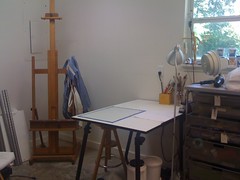
Studio, waiting for me


As I look forward to the start of the school year and the opportunity to get back into the studio I am considering this quote from the Incomplete Manifesto of Bruce Mau:

3. Process is more important than outcome
When the outcome drives the process we will only ever go to where we've already been. If process drives outcome we may not know where we’re going, but we will know we want to be there.

This also explains why over-thinking tends to kill an idea.

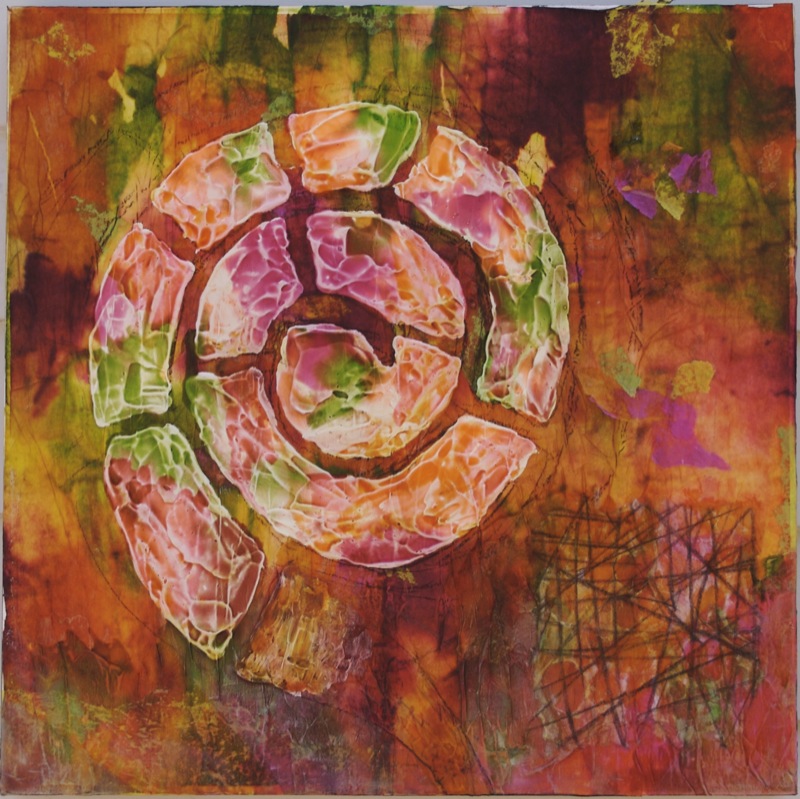
Over the next 5 months I aim to produce at least 50 paintings. I'm going to work smaller so that I can follow more ideas to completion and experiment more. I have no idea where I'm going to start and I am not letting myself think about it either - I don't want to make the ideas stale. But I expect a lot of experimenting with process and materials.

The studio is getting a 'summer clean' and a total rearrangement so I can have more wall space to hang works-in-progress and sketches. After visiting several artists' studios this year I got wall space envy!

Wednesday, April 29, 2009

How can I find time to create?!

Ideas board

My Ideas Board as of this morning

Friends and neighbors often ask me "How do you find time to paint? I don't know how you do all this". Mostly it just takes determination, but here a few tips I picked up along the way:

Finding Time


The most common advice I see for fitting in a new activity is to schedule it as an appointment, and then keep that appointment as you would any other. I agree with this - it works and over time will make creative time an essential habit. It sounds so simple but there is a first step that is almost never mentioned: before you start making appointments (only to break them or let them slide by because something else gets in the way), you must make a commitment. You have to be committed to keeping those appointments or rescheduling only if you have to.

Vague ideas to be 'more creative' will not happen. Make the time. Perhaps schedule a creative playdate with a friend, preferably one who is not too chatty!

If you think you have NO time at all in your week try this: keep an hour-by-hour note of your activities throughout the day - from waking to sleeping. If you have a job to go to you can simply blank that section of time out of course! Note down your energy levels too - are you buzzing in the mornings or are you a night owl? You need to know your best time of day to work. From these notes you should be able to identify a window or two when you could create - perhaps instead of watching TV or surfing the web.

Location, Location, Location

Do you have a place where you do your creative work? It doesn't have to be a dedicated studio, it can be the kitchen table, but does it have good light? Do you enjoy working there? There may be some simple changes you can make, like rotating a desk so you get more light from the window.

Where are your supplies stored? They should be close by your work area and all together. Being able to quickly pull out a box and get going makes a huge difference.

This all brings me to one thing: distractions. What are yours? Mine are the computer, annoying levels of mess and New Projects. I can wander off on a New Project tangent for days. Try and have your work area isolated from your main distractions!

Flexibility, a.k.a. Yoga for Schedules


As my friend Anne says, "Stuff happens". Actually she isn't as polite about it as that, but she's right - stuff does happen. Sometimes the stuff is out of our control and all we can do is cope. Sometimes the stuff is actually bad planning - taking on way too much all at the same time.

For these reasons, our schedules need to be able to adapt and then have the creative windows reappear. Some things you can try:
  1. Have an essentials list - these are the things you absolutely MUST do each day or week in order to feel balanced and sane. This list might include taking a bath, swimming, drinking enough water, writing in a journal for 15 minutes or spending 15 minutes a day with your sketchbook. These are the things that you will keep up even when the world goes crazy around you so that you will be able to cope.
  2. If time crunches become too regular then make a "to stop" list - a list of activities you will give up so that you can find more time to be creative.
  3. Write out your commitments for the next 3-12 months and keep a rolling calendar of these - don't let your 'current projects' list get too long: 3 is more than enough and yes, major family activities are a project. Are there any clashes? Do too many projects fall due the same week or month?

Small Steps


But what if your schedule goes up in the air like this - how do you get back into the studio? When all is chaos, do NOT stop doing creative things, just scale them down. One secret in getting back to work is to never truly stop. Try to spend moments with a sketchbook, or flick through your idea books. Stressed? Tidy and clean your workspace so that you are ready to go when you are better able to focus and be creative.

Getting Back into your Stride


If you didn't manage to keep working it can be hard to get going again. Perhaps you lack an idea or can't remember where you left off. Believe me when I say that the hardest part is starting - even if you rearrange your pens or paints for 30 minutes you will have started. For some reason a tidy work surface is a magnet for new creative work. If that doesn't do it for you, pull out a book and try a new technique or play with color exercises. Spend your entire, scheduled creative time doing something, however hard it feels. It will get easier.

I find it helps to have some kind of goals and long-term structure to my creative time. For a while I got this from external courses, but now I have a self-imposed goal to direct my work: I'm working on a series of paintings on the theme of trees. Even without access to classes a structure can be found: Krista Meister has set herself a self-directed curriculum of art studies. Very inspiring!

And what do I, personally do?


I try not to schedule too much into a single week or over-commit on other activities. I do volunteer at the school but mainly in the classroom and never more than I am happy to do.

It helps that my studio space is in the garage, away from the house, the phone and the computer. And only 10 seconds commute time. I go out there with my coffee as soon as the youngest is in school (9a.m.) and stay there until it's time to pick her up (12 or 2:30). If I run out of ideas or things to work on I tidy up a bit, make some fresh coffee and then push some ideas around in a sketchbook.

Writing this post has been a great reminder for me - 'stuff' has really happened and I'm reminded that I need to re-focus on the most important things and put the rest on hold.

Some blogs that have helped me treat my creative time as working time and learn to be a freelancer:
Productive Flourishing
Zen Habits

Wednesday, February 18, 2009

What is it like in the right hemisphere?

As artists we spend time in the right hemisphere of our brains, but what is it like to be totally there, to have no left-hemisphere? In this TED talk Dr Jill Bolte Taylor describes what happened when a stroke cut off the left hemisphere of her brain. This will surprise and move you.

Thursday, January 8, 2009

Book review: Talent is Overrated by Geoff Colvin

Talent Is Overrated is a very readable study, backed up by scientific research, into why some people achieve great success. The answer? Not talent, but great effort: a type of effort called 'deliberate practice'. This book suggests that around 10 years of deliberate practice are required for someone to master their chosen skill or knowledge area. This is consistent with the 10,000 hours suggested in Katherine Tyrrell's blog, Making a Mark, here.

The author goes into depth on what deliberate practice consists of, giving examples from the world of writing, sport and business. Geoff Colvin is Senior Editor at Large at Fortune magazine so his main focus is on how a business person or company can take the deliberate practice principles and apply them. He also devotes a chapter to how deliberate practice can enhance creativity, postulating that this is, and increasingly will be, an essential skill in business. These principles could be applied to any skill area and I believe that includes painting, perhaps because it is a subject I have been thinking about for some time (see my earlier post on music practice and art).

In fact, reading this book has helped me understand some areas of Josh Waitzkin's book, The Art of Learning, specifically the chapter on 'Numbers to leave Numbers' - how experts spend so much time studying the basic units of their skill (chess pieces in Waitzkin's case) that they stop seeing individual pieces and start seeing groupings: a little like a beginner reader learns letter sounds, then letter combinations, building up to words. I recommend reading these books together to get a good grasp of how we can each take control of our learning in all areas of our lives.

I confess to being fascinated by the concept of deliberate practice (remembering the satisfaction from a good music practice session as a child) and excited at all the possibilities this could open up. Finally, I think I see a way to structure my own studio time without needing an external course to provide that structure. Perhaps, after 37 years, I am ready to leave school?

Tuesday, October 7, 2008

Practicing art, and how that relates to music

I grew up studying music: three different instruments in fact. That's a lot of practicing each day! So I have a lot of music study experience with a framework for practice. I loved to draw as a child but art was just another subject at school, not a major part of my extra-curricular life. I have never studied or practiced art in an even vaguely organized manner.

Does this matter? I believe it does.

In The Art of Learning Josh Waitzkin suggests that to be good at a skill, really good, you must learn the basics in depth. Twyla Tharp agrees with this opinion in The Creative Habit, giving the example of the exercises a ballerina does each and every day. Not that I think there isn't a place for free-wheeling work, or for exercises that help one to become more creative. I truly think that it's easier to free your creativity when you are also working on improving those basic skills.

But what are those basic skills? I thought about all the music exercises I did as a child and tried to think of the visual art equivalent and I came up with the following:

MusicArt
Scales & ArpeggiosDrawing & Mark-making
StudiesStudies of Values, Color, Composition
ImprovisingPreliminary work for paintings, Sketchbook use
Music theoryArt history
Instrument careKnowledge of materials - paint, mediums, papers, canvas etc.


Having grown up with a framework for music practice I'm interested to find an equivalent structure for improving my visual art skills. I'm always interested in learning: if you see any skills I have missed in the list please let me know!

Thursday, September 25, 2008

3 Things I learnt about Simplicity

Image coutesy of Thys.4f

The last 2 weeks 'forced simplification', a.k.a Hurricane Ike, came into my life. I had no power and thus no web-surfing or other time-wasting for 9 days. All the volunteer projects I had going on this months were cancelled. This has left me with the bare bones of my life - my family and my art, and I'm loving it!

So what did I learn?
  1. I thought automating my life by scheduling regular activities would simplify things and free up more mental space for creating. And it does. Having no power, no school (for the kids), no structure to the day made creativity very hard. I drew some but I just could not focus. As soon as I had power back I could rise early and spend an hour in the studio before light. I rediscovered my flow instantly! Habits really are key.
  2. However, habits can only go so far. I was volunteering way more time than I am happy about. Choosing the activities and projects that come into my life is vital. I need to pick and choose more. Way more. And be more careful about dates and scheduling - I had three projects coming due this week!
  3. I need to be professional about my art. It isn't something to be rescheduled for next-to-nothing. If I don't treat studio time like a job, how can I expect others to?

Monday, September 8, 2008

Simplicity and Creativity

These last few weeks I have had the sinking feeling that life is spinning out of control. This happens when I have over-estimated what I can fit into my life and have over-committed myself. This months I have two community projects I committed to that are due by the 26th, and I started my latest class at Glassell - Abstract Painting Essentials - with a VERY demanding teacher and a tight schedule. I need to complete the first painting by Wednesday morning and this is what I have so far:


Doesn't look like much does it! So, I am getting a bit panicked to say the least.

Then, this morning I read Leo at Zen Habits post about simplifying and the following really spoke to me:

  • Deflect all requests for a week. If you’re feeling overwhelmed, make the decision that you will not say “yes” to any new requests this week. If you get a new request, politely decline. If it’s a request you can’t decline, tell them you’ll get to it next week because you have some projects you need to finish this week. Then pick one or two or even three projects (depending on their sizes) and focus on finishing them this week. You can worry about new stuff next week. Repeat this hack when needed.
  • Limit yourself to one project. How many projects are you juggling right now? If there are too many, you might be limiting your effectiveness. Instead, focus on one project right now, and put the others on the back-burner. Try to get that one project done as quickly as possible, and then work on the next one.


You can read the whole list here.
Terribly simple, but it doesn't occur to me to do this when I'm so swamped. I sometimes wonder if I overcomplicate just to avoid the urgent project! This week, then, I am going to focus on the painting and on getting my life back on 'auto' setting. More about that 'auto' setting thing later...


Thursday, July 3, 2008

Fierce and original


"Be steady and well ordered in your life so that you can be fierce and original in your work." Flaubert


I take this phrase to mean a tidy, organized work space; a regular working time; as few distractions as possible.

But what about my 5 and 3-year-old distractions? Whilst it can be a lot of fun being a Mom, young kids do not sit easily with creating over the long, summer months. Getting up early to create left me exhausted and totally out of phase with my night-owl husband so I have (voluntarily) lost my regular working time in favor of additional patience.

I'm left musing on how I can use this advice in my real world. I thought finding time to create would be easy once I was at home with kids. Now I realize it's never easy - you really do need to be "steady and well-ordered in your life".

So first I listed where I am, right now. This includes:
  • My most important role right now is to enjoy this time with the kids and try to gently teach them reading, writing, life skills (like tidying their room)
  • I'm about to be on the road for 3 weeks
  • I need the help of the people around me to get uninterrupted studio time

    Then I thought of solutions that accept the world as it is:
  • I could work on projects with the kids. I'll be interrupted (constantly) but I'll have to deal with that.
  • I can draw more, drawing the kids as they play for instance
  • I can work small and in the kitchen, so no more acrylic medium experiments for now, they take too long to dry
  • I can get up early next week - it's preparation for jet lag and I can survive 3 early mornings I think

    I'll be going back to that quotation of Flaubert's in a future post. Blogs and books I've been reading recently have led me to a series of realizations that are going to change how I approach, well, my whole life.

  • Wednesday, May 21, 2008

    Preparing for a journey

    I am so excited about this journey I'm planning to undertake - 3 months of pure fun and experimentation. Right now I am like someone preparing for a long trip. I'm saying my goodbyes (selling some paintings) and packing (tidying my studio).
    Today I took 13 paintings to the studio school sale and I'm feeling sadder than I thought I 
    would. I just realized I've said goodbye and seen some of those paintings for the last time. All I have left are photographs and memories of their creation. I wonder which will sell and which will come back to me?
    This is my studio right now:


    There's a lot of 'packing' to be done as you can see! It looks really empty now that there aren't 13 large canvases propped up against every vertical surface. I've been painting big recently - up to 48" square and I think I'm ready to down-scale.