Showing posts with label artists. Show all posts

Saturday, February 5, 2011

Color and Kinetic artists

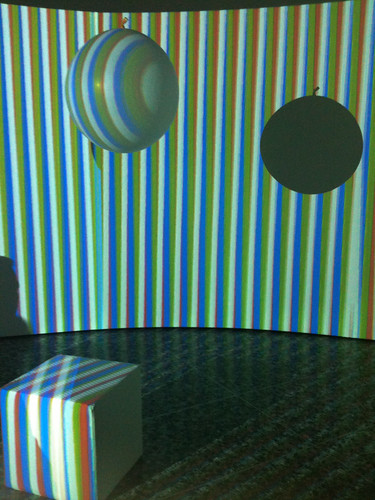
Spiral room at Color in Space and Time

Spiral chromatic room at Color in Space and Time


Over on my new blog and website - so new and so shiny! - there have been some blog posts:


Later today I will be posting about the Carlos Cruz-Diez retrospective at the Museum of Fine Arts, Houston, Color in Space and Time which opens tomorrow, but I previewed last night. First I have a lot more photos and video to upload and his lecture at the museum to attend.

Thursday, October 7, 2010

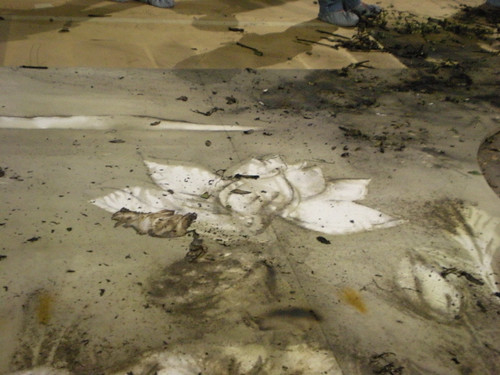
The Odyssey explodes: Cai Guo-Qiang's gunpowder drawing ignites


Last night I had the honor to assist Cai at the ignition ceremony, putting down cardboard, handing him bricks and putting out small embers.

Each of us who had helped Cai felt some ownership of the success or failure and therefore some anxiousness and anticipation as the fuse was lit. After so much preparation the actual creation of the drawing was fast and loud. Then it was followed by an agonizingly slow reveal of the drawing from under layers of cardboard and glassine.

I was amazed by the delicacy in some areas and the strong, dark lines in others. The drawing has changed so much from his pencil sketch and not simply in scale. In the video above he mentions that perhaps the volunteers will be able to point out to their families and friends the areas that they worked on. Well, I can say with pride, here is the lotus flower that I worked on, and didn't Cai do a fantastic job of bringing out its delicacy?
The lotus flower in Odyssey

A lotus flower from Odyssey

Wednesday, October 6, 2010

Tuesday at the warehouse

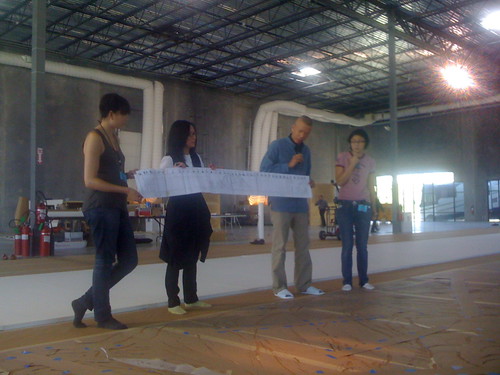
Cai Guo-Qiang explaining his Odyssey sketch

Cai Guo-Qiang explaining his Odyssey sketch


Tuesday saw a live audience join the cameras in observing the Odyssey project. Luckily the audience do not pay to attend since the first two hours they were watching four museum art handlers lay out the panels. Those guys made the panels look so easy to manoeuvre, but I know better! Once that was complete, however, Cai Guo-Qiang spoke to the audience and the volunteers to explain the project and his vision.

The 42 panels of Odyssey will line the walls of the Arts of Asia gallery at the MFAH, and will be a backdrop for the other works of art. For this reason Odyssey is part landscape - a traditional Chinese landscape of mountain and waterfall - and part Chinese garden with peonies and lotus flowers. Cai quoted a Chinese saying "Tall mountains and flowing water welcome a dear friend" and mentioned that he was giving flat Houston its own mountain.

Right now his drawing, which we have converted into a stencil, looks very related to the long tradition of chinese landscape painting. However, I cannot even begin to imagine what it will look like by late Wednesday. Look for yourselves - from 9 a.m. on Wednesday the action will be live online at culture map.
After Cai spoke we lifted the stencil, in three large sections, and placed it onto the panels. That sounds really easy, but it's not! It took a long time to get each section straight as some of the more delicate and intricate areas threatened to rip and collapse in transit.
Working on a glassine and card mask for Odyssey

Working on a glassine and card mask for Odyssey

Our final task of the morning was cutting masks from glassine paper and card to place over areas of the stencil. I believe these are used to direct the smoke and reduce the oxygen to create different marks with the igniting gunpowder.
Who know what I will be doing tomorrow morning? Stripping fuses or holding a bowl of gunpowder perhpas! Whatever we are doing will be fascinating since I am working with a great group of people for a man who exudes calm and serenity.

Tuesday, October 5, 2010

Counting down to Cai's Odyssey

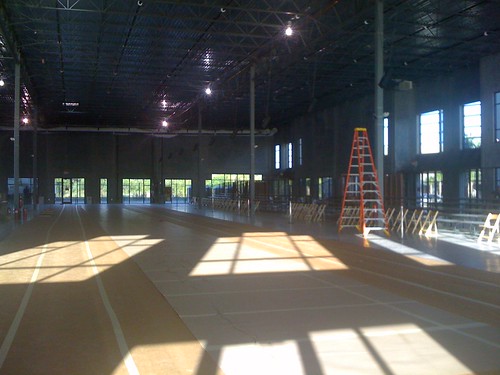
Odyssey location

Odyssey warehouse location


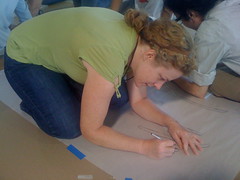
This morning I joined around 30 others to work on Cai Guo-Qiang's Odyssey. They let us loose with X-acto knives, cutting around the brush marks that Cai made, to create a cardboard stencil. None of us volunteers knew each other before we started, but after you've worked on your knees, side by side trying not to stab each other with a knife, you bond pretty quickly.

Cai works from a long drawing, a little like a scroll painting, using a long stick with a Sharpie for drawing and a wide brush for painting. Although there must be a lot of planning involved, he does make adjustments and changes as he works. Although he has a lot of assistants, they are mainly carrying out and translating his direct instructions, or overseeing standard work such as taping the stencil so that it can be moved around. I have often wondered how much an artist does when they have assistants or volunteers, and I can say that I am not adding one iota of creative input to this project. All the creative decisions are coming from Cai.

Today we learnt that the volunteers will NOT be handling the huge panels. What a relief. I would much rather point out the areas where I cut the stencil than the dent in the panels where I dropped one.

The Houston site Culture Map has a series of articles on the Odyssey work and they will have a live webcast of the work on Wednesday leading up to the ignition ceremony in the evening. There will also be an ignition party at St. Arnold's Brewery.

The above photograph is the only one I will be able to post. Although there are cameras around us at all times (which is a little off-putting at first when you're crawling around on hands and knees with your behind in the air), the volunteers are not allowed to take photographs. If I get chance I will make some quick drawings of us working.

Monday, October 4, 2010

Cai Guo-Qiang at the MFAH

In an unassuming, newly built warehouse in Houston, artist Cai Guo-Qiang will be creating a gunpowder drawing, "Odyssey", at the Museum of Fine Arts Houston and I will be one of his volunteer helpers.

The location is fascinating - a new warehouse, temporary air-conditioning, baseball bleachers for the audience, a speaker system, and fire extinguishers everywhere. On Saturday we had some training there, which was mostly a background of Cai (pronounced "Tsigh"), followed by a practice with one of the panels for the drawing. The panels are HUGE, 10 feet long by maybe 5 feet wide, and they must weigh about 80lbs. I know because I was lifting the bottom edge off the dolly and had half the weight on my hands. We have to be very careful not to touch the front surface or drop them. Imagine trying to move a giant, fragile panel with three strangers when you can barely touch the thing. There are 41 of them and I get the feeling we'll be laying them out this morning. Advil anyone?

I'll be posting more, maybe with location photos later. For now, here is a video of Cai at work on a gunpowder drawing in a warehouse on Long Island:

Wednesday, August 5, 2009

A visit to the Whitworth, Manchester

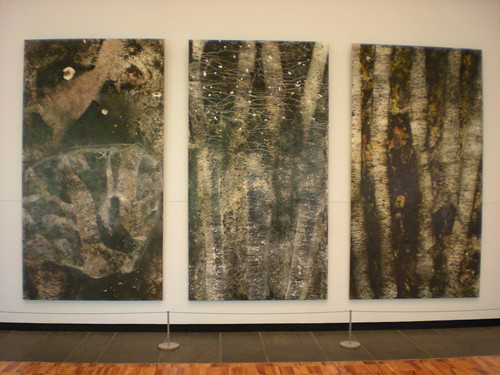
Triptych: Sliver Birches & Bindweed & Beneath a Rotting Tree by Michael Porter

Whitworth Art Gallery, Manchester, UK

At the weekend I went up to visit my old stomping ground, Manchester, where I went to university. Going into the Whitworth Art Gallery, I found they had an exhibition on that was fascinating to me - a real touch of serendipity. The "Deep Rooted" exhibition is all about trees, and introduced me to a contemporary artist, Michael Porter (b. 1948), who paints trees, many of which are from the same wood in Derbyshire.

He walks in the woods making notes, rather than sketches, and then returns to the studio to paint, aiming to capture the memory of a place and its change over time. The paintings grow over time too, taking around six months to complete and involving oil and water based paints. The visual and physical textures on these paintings are fascinating.

The paintings above are hung in the south gallery of the Whitworth, overlooking Whitworth park and the trees outside. They had an iPod with audio files as part of the exhibition and I listened to a couple of tracks that were Michael Porter talking about his work in painting trees. He didn't talk about his materials disappointingly, but he did mention that he takes photographs on his walks. He has been walking in that Derbyshire wood for twenty years and found that he tends to photograph the same trees over and over, recording their appearance and growth over that entire time period.

Sadly the gallery store closed before the gallery (why?) so I didn't see if they had any catalogs for the exhibition or postcards, but I saw from his website that Michael Porter has a book of his paintings.

Thursday, July 16, 2009

Ecstatic Encounters with Art no.1

Apple Tree in Blossom

Piet Mondrian, Oil on canvas

My first memory of seeing Art is at the Aberdeen Art Gallery and I must have been maybe 7 or 8 years old. My next is going to Arken museum of modern art north of Copenhagen, Denmark when I was 9 or 10. I remember a gold thumb that was about as tall as I was and very detailed with skin texture and thumb print lines. Maybe a model for the thumb at La Défense in Paris? I've been back since and, as an adult, it didn't seem such a magical place, and the thumb was no longer there. I think I was as taken with the white building, blue sky and sunshine as I was with the Art inside. Perhaps a 9 or 10 year old, being more playful than an adult, is more open to cutting edge modern art. It's sad to think that, even as an artist, I haven't kept that same open-minded playfulness but Picasso was right - it is hard to stay a child once grown up.

Although I enjoyed these early encounters with art, I cannot remember many specifics, but my first ecstatic encounter with art was as a 13 year old. My mum (mom) was studying Modern Art with the Open University (a distance learning college in the UK) and was often doing her homework whilst we did ours. She showed me Mondrian's trees - one of which was definitely Apple Tree in Blossom above, and asked me what I thought the painting was of. I knew right away that it was a tree and we had a discussion about the roots of abstraction. I think her studies were the start of my love for abstract art.

Mondrian (1872-1944) was a de Stijl artist and Theosophist who believed "that his paintings could change the objective conditions of human life."
Robert Hughes, The Shock of the New

Mondrian came to abstraction from Expressionism, via Cubism applied to nature (his trees). He was very religious and saw his grid paintings as 'icons' for Theosophy.

Recently we discussed Mondrian and the grid in Abstract Essentials at Glassell - how Mondrian looked at man, trees, buildings and their verticality against the horizontal of the flat Dutch landscape - and from his tree and then ocean/pier paintings developed his grids.

"We find that in nature all relations are dominated by a single primordial relation, which is defined by the opposition of two extremes. Abstract plasticism represents this primordial relation in a precise manner by means of the two positions which form the right angle. This positional relation is the most balanced of all, since it expresses in a perfect harmony the relation between two extremes, and contains all other relations."
Piet Mondrian, "Natural Reality and Abstract Reality", 1919
quoted from Theories of Modern Art, Herschel B. Chipp

He believed that true abstraction should be verticals and horizontals with primary colors only, and argued with his friend Theo van Doesburg, the founder of the de Stijl group about this as Doesbury used diagonals in his work.

"Doesburg, in his late work, tried to destroy static expression by a diagonal arrangement of the lines of his compositions. But through such an emphasis the feeling of physical equilibrium which is necessary for the enjoyment of a work of art is lost. The relationship with architecture and its vertical and horizontal dominants is lost."
Piet Mondrian, statement, ca. 1943
quoted from Theories of Modern Art, Herschel B. Chipp

Personally I like the diagonals and the angles in these earlier tree paintings of Mondrian's - the very angles which he later rejected - but I grew up in Scotland which is all angles and slopes, would I feel differently if I came from a flat country like Holland?

Tuesday, July 7, 2009

Drawing glassware

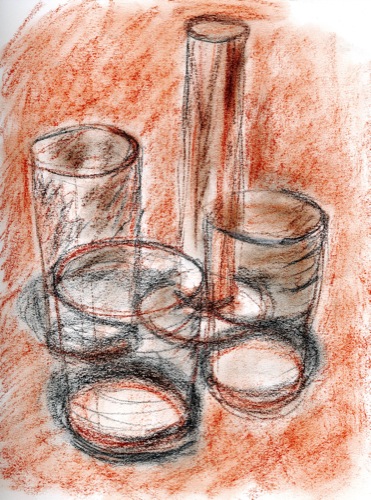
Conte sketch of glasses

©2009 Caroline Roberts

Today's daily sketch of a selection of glasses. Like Morandi I plan to draw these over several days, trying to capture the complicated pattern of reflections and shadows and lose the outlines of the glasses. The outlines and the shadows ended up too heavy (in my opinion) in this sketch. But that's what practice is for!

Georgio Morandi: Still Life (1916)

This is one of my favorite Morandi paintings. I love the muted colors and the flat shapes of the bottles and pitchers. His paintings generally have a serenity to them that I enjoy, but this one seems to have a movement with the serenity, like a graceful dance. I think it comes from the portrait format, the long bottle shapes and the acute angles of the shadows.

Ben Nicholson: 1945 (still life)

I haven't read enough on either artist to know for sure, but I do think that Morandi's work influenced Ben Nicholson's still life paintings. I like the way that Nicholson added his own twist to cubism. He separates outline from form and somehow achieves unmistakable depth using flat shapes. I think it's those cunning slivers of shadows.

With these two masters as my guides I shall be tackling those glasses again...

Friday, November 21, 2008

Tina Mammoser's Work in Progress Series


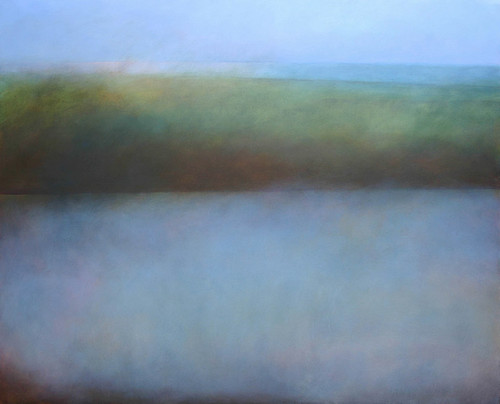
Thornness Bay, Low Tide, originally uploaded by tina-m.

Tina Mammoser, whose artist blog I follow, is running a series of blogs about a work-in-progress that I'm finding fascinating. I love reading about how other people put their paintings together, especially ones as beautiful as Tina's. This is the canvas the series is about - Thornness Bay, Low Tide.

So far Tina has blogged about:
- Source and preparation
- Underpainting
- Midlayers of color

I can't wait to see the post tomorrow about the final glazes. I've found this series very inspiring!