Showing posts with label health and safety. Show all posts

Tuesday, February 17, 2009

Paint Safety and Acrylic Painting Tips

Following on from my post on paint toxicity, I have a few tips for working with acrylic paint. A lot of people seem to find the fast drying time an issue, and it can be. I find drying time to be extremely unpredictable - in winter my paint dries pretty slowly but in summer it can be dry almost before the brush stroke is finished! It all comes down to humidity and temperature, although, in my experience, the heat here in summer outranks the high humidity and my paint still dries fast. However, it's probably far faster in Arizona.

Before I start however, a twitter contact, Edward Kinnally, let me know about an article he wrote on art material safety which covers the standards applying to paint. Ever wondered what "non-toxic" really means? That one was a shocker for me.
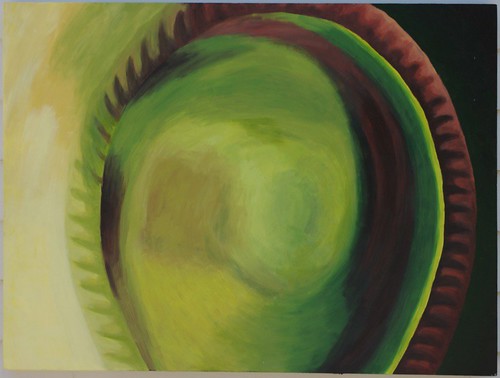
Perrier Bottle

30"x40" acrylic on canvas

2007 Caroline Roberts

So, how can we blend when the paint dries so fast? Here I painted the base of a perrier bottle in the (attempted) style of Georgia O'Keefe. I used acrylic paints and in some areas I managed blending that I am very pleased with. My 'trick'? I mixed the main hues that I needed ahead of time and worked one small blending area at a time, blending my paint as much on the palette as on the canvas. I also keep a spray bottle on hand and regularly mist the palette and the canvas to keep the paint workable. When I feel the paint dragging at my brush I stop work on that area - the dragging means that a skin is forming and continuing to work will only make the paint textured and lumpy. If I have to stop before I'm happy with the blending then I simply come back after that layer is dry and repaint the areas that didn't work.

For a palette I mainly use a piece of glass with white paper taped underneath. I spray it regularly with water to keep the paint from drying and i cover it with plastic wrap (or cling film in the UK) to keep it from drying between sessions. I also use freezer paper which is the same as those disposable paper palettes but much cheaper. I have a stay-wet palette but I don't often use it because I find the surface a little small. It's good for studies and smaller canvases. Depends how big, or messy, you work really. For large quantities of paints or glazes I re-use paint pots, glass spice jars and plastic medicine pots. I am probably stating the obvious, but if you restrict the surface area you slow down the drying, so these little pots can keep a glaze workable for weeks if I close it up after use.

Now, I freely confess, I have very little experience with oil paint because I don't like the smell of turps and I have eczema so have avoided mineral spirits (this was before I learnt I should wear gloves whilst painting). What a career-long oil painter might see as restrictions on their normal way of working I see as normal limitations of a media.

Which is all another way of saying that I am making assumptions, based on the blog posts I read about acrylic paints, on the issues people find when they are new to acrylics. I would love to hear your questions so I know the real issues, and I will answer them as best I can. I am always learning something new about acrylics and I know there is so much more out there to know. I will share any discoveries I find to be repeatable.

Monday, February 2, 2009

Toxicity of Pigments

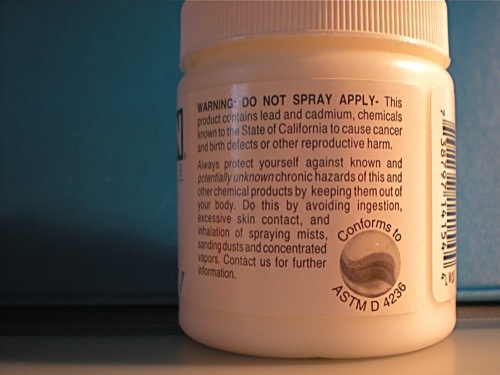
Hazard information on zinc white acrylic paint

I have a confession to make. I have a background in the chemical industry. So when I see those hazard warnings on the back of my paints I take notice. Health and safety isn't often mentioned in connection with fine arts, but we are exposed to more toxins than we may be aware of. You may know that the cadmiums are toxic but what about your other paint colors? Are they toxic? I am not saying do not use toxic paints. In fact, my research leads me to believe that would be pretty much impossible, but you should know what you are handling and take care.

A little chemistry: most, but not all, of the toxicity issues are associated with heavy, or toxic, metals such as copper, cobalt, cadmium, lead. Over time these poison the body and many are known or suspected to be carcinogens. If you remember your periodic table from chemistry, these are transition metals from that central section. So a quick rule of thumb is that if there's a heavy metal in the pigment name, it's probably toxic.

Below are lists of highly toxic and moderately toxic pigments used in acrylic and oil paints, possibly in pastels and other dry media too. Since color names can be inconsistent, the pigment name follows in parentheses. The pigment used is usually listed somewhere on the tube - see photo. Also, the paint manufacturer will have Material Safety Data Sheets (MSDS) on their website. Some of the 'hue' colors contain less toxic pigments, e.g. my Cadmium Red Hue contains Toluidine Red (moderately toxic) in place of Cadmium Red (highly toxic), however it is not as opaque as a true cadmium red.

Pigment names on different brands of acrylic paint


NB This list is NOT exhaustive. I pulled up the MSDS on the Golden website to check some of my paints and was shocked to find that almost every color they manufacture has some kind of toxicity issue associated with the pigment.

After the lists are some pointers on handling your toxic paints safely. Hopefully you know and follow these already!

Update: After posting this I found a posting on art material safety by Edward Kinnally that summarizes all the standards, such as ASTM and the term "non-toxic". A very in-depth and useful resource.

Highly Toxic Pigments
  • antimony white (antimony trioxide)
  • barium yellow (barium chromate)
  • burnt or raw umber (iron oxides, manganese silicates or dioxide)
  • cadmium red, orange or yellow (cadmium sulfide, cadmium selenide)
  • chrome green (Prussian blue, lead chromate)
  • chrome orange (lead carbonate)
  • chrome yellow (lead chromate)
  • cobalt violet (cobalt arsenate or cobalt phosphate)
  • cobalt yellow (potassium cobalt nitrate)
  • lead or flake white (lead carbonate)
  • lithol red (sodium, barium and calcium salts of azo pigments)
  • manganese violet (manganese ammonium pyrophosphate)
  • molybdate orange (lead chromate, lead molybdate, lead sulfate)
  • naples yellow (lead antimonate)
  • strontium yellow (strontium chromate)
  • vermilion (mercuric sulfide)
  • zinc sulfide
  • zinc yellow (zinc chromate)

Moderately Toxic Pigments
  • alizarin crimson
  • carbon black
  • cerulean blue (cobalt stannate)
  • cobalt blue (cobalt stannate)
  • cobalt green (calcined cobalt, zinc and aluminum oxides)
  • chromium oxide green (chromic oxide)
  • Phthalo blue and greens (copper phthalocyanine)
  • manganese blue (barium manganate, barium sulfate)
  • Prussian blue (ferric ferrocyanide)
  • toluidine red and yellow (insoluble azo pigment)
  • viridian (hydrated chromic oxide)
  • zinc white (zinc oxide)

How to handle toxic paints safely
  1. Do not use the same containers for paints that you do for food or drink. Well, duh, but thought I'd put it in anyway.
  2. Do not put paint brushes in your mouth! Use a brush holder or a piece of kitchen towel.
  3. Wash hands thoroughly after each painting session.
  4. Even better, wear latex gloves whilst painting, or at least whilst using the toxic pigments. I hate wearing gloves but after researching this topic I will be wearing them. Simple as that.
  5. Wear a dust mask if you handle pigment powders. Make sure it's the right one and keep it clean!
  6. Do not have food in your studio and use covered drinks containers.
  7. Since we don't want heavy metals in our rivers either, wipe up paints with kitchen towel and dispose of in the trash, not down the drain.
  8. If you sand your paints at all (as an acrylic painter, yes I do) then wear a respiratory mask. Keeping the paint surface damp as you sand also keeps the dust down.